 Adithyan Ravikumar
 The Biennale and the Port That Disappeared
Muziris was once the richest port in India. Then a river erased it. Walking through Fort Kochi during the biennale, that history hits differently.

I finally went to the Kochi-Muziris Biennale. Six editions in, and this was my first. I caught it in the final days of March, right before it closed.
The art was interesting but it wasn’t the art that stuck with me. It was walking through Fort Kochi and Mattancherry between venues. Past the Chinese fishing nets, through the spice markets, past old synagogues and Portuguese churches and colonial warehouses that now hold contemporary installations. Fishermen murals on compound walls. Entire building facades painted over in colours loud enough to stop traffic. The whole area feels like a place where the world showed up and left pieces of itself behind. Every lane has a different century’s fingerprints on it.


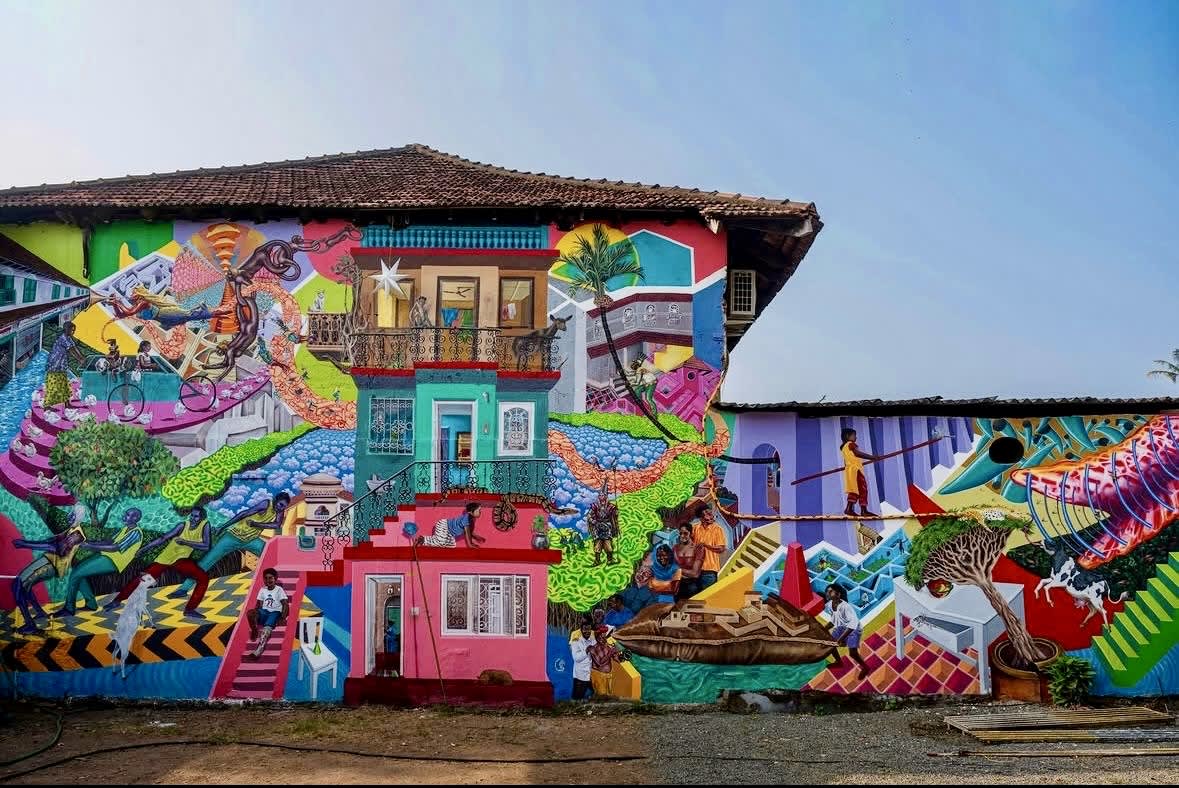
The theme this edition was For the Time Being. Walking around Fort Kochi, that felt less like a curatorial choice and more like a fact.
And somewhere between the second and third venue, the Muziris part of the biennale’s name started bothering me in the best way.
The Port
Most people I know have only a vague sense of what Muziris was. An old port. Somewhere near Kodungallur. Mentioned in school textbooks and then forgotten.
Here’s what it actually was.
About 25-30 km north of present day Kochi, near the village of Pattanam, there was a harbour that ran for roughly six hundred years. Roman, Greek, Chinese, Jewish, and Arab merchants all traded here, mostly for black pepper. Romans were shipping gold across the Indian Ocean to buy spices from this one stretch of coast. A single harbour town in Kerala was pulling Roman gold two thousand years ago.
Also, three old religious sites sit within this same stretch of Kerala coast: the Cheraman Juma Masjid, believed to be India’s first mosque, the Kottakkavu Mar Thoma Church, one of its first churches, the Paradesi Synagogue, the country’s oldest. These faiths arrived centuries apart, but probably entered India through essentially the same door: Muziris.

And then the Periyar flooded in 1341. The river shifted course, the coastline changed, the harbour silted up. Muziris simply stopped existing. The port had quieted over the centuries, but the flood finished it. The water took what remained.
What Stays
Stand here long enough and you start to feel that the flood didn’t end anything. It just relocated it.
Muziris is gone but nothing it brought here left. The synagogue, mosque, church, all are still standing. The spice trade that started there eventually pulled the Portuguese to Kochi, then the Dutch, then the British. When you walk here, you’re walking through the afterimage of a port that doesn’t exist anymore.
One installation made this land harder than anything else. At Anand Warehouse, a colonial era godown that the Dutch and then the British used to store goods, an artist named Ibrahim Mahama had lined the walls with old jute sacks, the kind that once carried pepper and grain out of ports like this one. Over a hundred salvaged chairs faced each other across the room. In a building that was the spice trade, now holding art about it.

You look out toward the harbour and the fishing boats are still there, Malayalam names painted on their hulls, and behind them the container cranes of Cochin Port. The same coastline, still moving goods.

This coast has been absorbing visitors for two thousand years, and Muziris was the original reason why. The port vanished, but the pattern it created is still running. That’s why the biennale works here. The place isn’t a backdrop. It’s the main exhibit. The installations give you something to look at. The walk between them gives you the context to actually feel it.

Photo credits: Not all of these photos are mine, thanks to my friend who shot a few of the good ones :)
Enjoyed this piece?
Tagged in
Share this
✓ Check your inbox to confirm!